An Introduction to NetworkUnit
with examples of comparing model implementations (C vs. SpiNNaker) and experimental data (monkey L vs. monkey N)
navigate through the slides with the spacebar or arrow keys
or view the Jupyter notebook by clicking the X in the upper left corner
When considering model simulations and their evaluation, it is important to precisely define the terminology and to be clear about the interpretation of the results in order to judge the validity and the scope of applicability of the model. For all practical purposes, in modeling one should be concerned with its testable correctness relative to the given system of interest, because only this process justifies its use as the basis for analytic reasoning and prediction making.
In 1979 the Technical Committee on Model Credibility of the Society of Computer Simulation established a widely recognized description of a model verification and validation environment. We adapt this terminology to the field of neural network modeling (Trensch et al. , 2018; Gutzen et al. , sub.). The validation setup is separated into three basic elements (see figure below). The system of interest can be defined as “an entity, situation, or system which has been selected for analysis” (Schlesinger et al. ,1979.), and constitutes the references against which validations are carried out. When specifying this system of interest it is important to also explicitly define the boundaries in which the modeling is expected to be adequate. The modeling effort itself is separated into the definition of the conceptual model, and its implementation as a computerized model. The conceptual model is an abstract description formed by analysis and observation of the system of interest. In the case of network simulations, the conceptual model takes on the form of a mathematical model describing the dynamics of neurons and the connectivity structure, and other dynamic features of the simulation (e.g., inclusion of neuromodulatory effects). An implementation of the conceptual mathematical model in a computer software or in hardware, on the other hand, results in a computerized, or more concretely for neural simulation, an executable model.
The process of evaluating the degree to which the executable model is a correct realization of the mathematical model is termed ‘verification’. In contrast, the comparison of the predictions generated by the computerized model to the system of interest considering its intended domain of applicability is the process called ‘validation’. Together with the process of ‘confirmation’, which attributes credibility to the mathematical model as a useful description of the system of interest, these three attributes form a circle that typically receives multiple iterations consisting of improvements of the mathematical model and its implementation as an executable model.
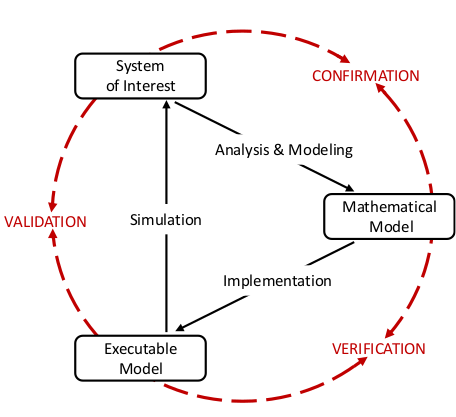
System of interest: an entity, situation, or system which has been selected for analysis
Mathematical model: an abstract description formed by analysis and observation of the system of interest.
Executable model: an implementation of the mathematical model
Confirmation: attributing credibility to the mathematical model as a useful description of the system of interest.
Verification: evaluation whether the executable model is a correct realization of the mathematical model
Validation: a quantitative evaluation of usefulness and accuracy
ProducesProperty contains the function calc_property(). The test XYTest has a function generate_prediction() which makes use of this capability, inherited by the model class, to generate a model prediction. The initialized test instance XYTest_paramZ makes use of its judge() function to evaluate this model prediction and compute the score TestScore. The XYTest can inherit from multiple abstract test classes (BaseTest), which is for example used with
the M2MTest to add the functionality of evaluating multiple model classes. To make the test executable it has to be linked to a ScoreType and all free parameters need to be set (by a Params dict) to ensure a reproducible result.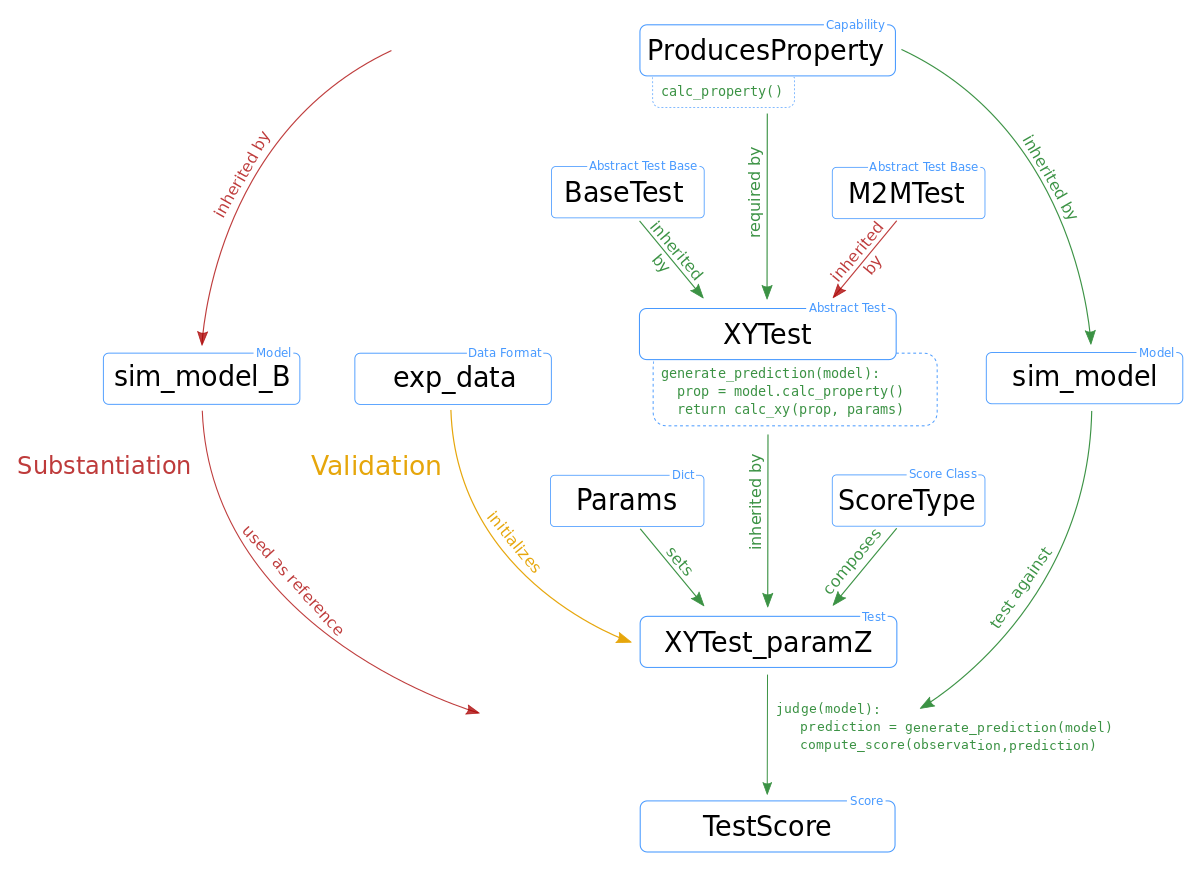
So far, we considered a scenario in which a model is compared to experimental observations. However, there are circumstances in which a model is the object of reference. This model could be another implementation of the model under scrutiny, an alternative model, or a different simulation run of the same model. In the following, we explore such validation scenarios, which we collectively term model-to-model validation. When using NetworkUnit every test comparing model to experiment
(example_test) can be transformed to a test comparing two (or more) models by inheritence of the M2MTest class.
class example_test_M2M(sciunit.TestM2M, example_test):
One possible scenario is the need to demonstrate the equivalence of alternative implementations of the same model. These implementations could, for example, be realized by different simulation engines, like in our first example by a C simulation and a simulation on the SpiNNaker hardware.
[1]:
%matplotlib inline
import sys
import sciunit
import numpy as np
import neo
sys.path.insert(0, '../')
from networkunit import models, tests, scores, plots, capabilities
from copy import copy
import os
import matplotlib.pyplot as plt
import seaborn as sns
sns.set(context='talk', style='ticks')
import warnings
warnings.filterwarnings('ignore')
Validating a SpiNNaker simulation against a C simulation
For this comparison we use a polychronization network model (Izhikevich , 2006) as it produces a rich repertoir of network dynamics. This model simulated with both a C implementation and an implementation on the neuromorphic SpiNNaker system.
The simulation data is available via a GIN repository from which it can be loaded into the local storage with git-annex (or alternatively the gin-client).
[2]:
# Clone gin repository
!git clone git@gin.g-node.org:/INM-6/network_validation.git

# load simulation data
os.chdir('./network_validation')
!git-annex get ./simulation_data/iteration_III/60s_simulation_runs/*/out_firings_after5h.dat
os.chdir('..')
data_path = "./network_validation/simulation_data/iteration_III/60s_simulation_runs/"
fatal: destination path 'network_validation' already exists and is not an empty directory.
On a remote server it is only possible to download the data with wget.
The simulation is implemented in a model class
The model class should either be able to run the simulation or else load data from a simulation (what we do here).
[3]:
class polychrony_data(models.spiketrain_data):
    file_path = '' # to be added in child class
    params = {'align_to_0': True,
              'filter_inh': True}

    def load(self, file_path, simulator, t_start=0, t_stop=60000, filter_inh=False, **kwargs):
        f = open(file_path, 'r')
        lines = f.readlines()

        N = 1000 # neurons

        # Read Spike Times
        spike_times = [[]] * N
        for line in lines:
            sec, msec, n = line.split(' ')[:3]
            t = float(sec)*1000. + float(msec)
            n = int(n)
            if t > t_stop:
                break
            spike_times[n] = spike_times[n] + [t]

        # Fill Spike Trains
        nbr_neurons = N
        if filter_inh:
            nbr_neurons = 800

        spiketrains = [[]] * nbr_neurons
        for n, st in enumerate(spike_times):
            if n < 800:
                n_type = 'exc'
            else:
                n_type = 'inh'
            if not filter_inh or n_type == 'exc':
                spiketrains[n] = neo.core.SpikeTrain(np.sort(st), units='ms',
                                                     t_start=t_start, t_stop=t_stop,
                                                     n_type=n_type, unitID=n)
        return spiketrains
For the model-to-model comparison we derive a model class for each implementation
[4]:
# C simulation
class C_sim(polychrony_data):
    file_path = data_path + 'C/out_firings_after5h.dat'
    params = copy(polychrony_data.params)
    params.update(color='#2173a3', simulator='C')

# SpiNNaker simulation
class S_sim(polychrony_data):
    file_path = data_path + 'SpiNNaker/out_firings_after5h.dat'
    params = copy(polychrony_data.params)
    params.update(color='#77b74a', simulator='SpiNNaker')
[5]:
C = C_sim(name='C')
S = S_sim(name='SpiNNaker')
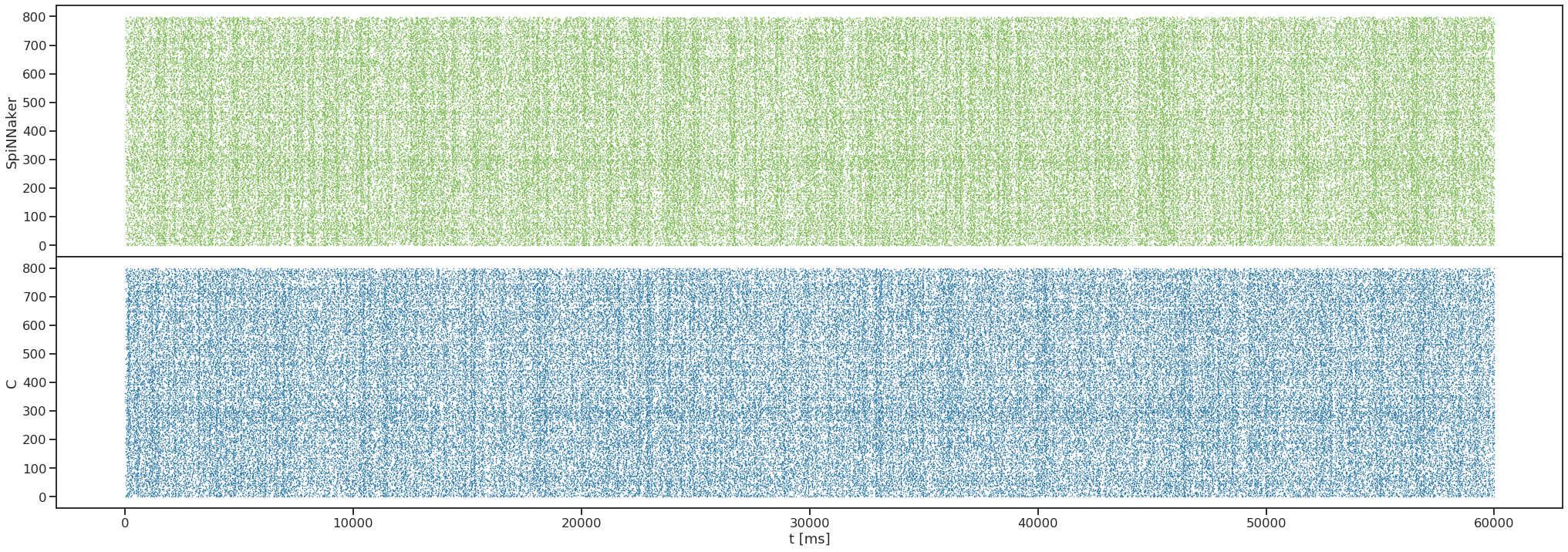
Show the spiking activity data
[6]:
fig, ax = plt.subplots(nrows=2, sharex=True,
                       gridspec_kw={'hspace':0},
                       figsize=(35,12))

for sim_count, sim in enumerate([S, C]):
    sim.produce_spiketrains()
    for st_count, st in enumerate(sim.spiketrains):
        ax[sim_count].plot(st, [st_count]*len(st),
                           color=sim.params['color'],
                           marker='.', markersize=1.,
                           linestyle="None")

    ax[sim_count].set_ylabel(sim.name)
ax[-1].set_xlabel('t [ms]');
Test definitons
The validation tests are also defined as classes. NetworkUnit offers a variety of base tests from which tests can be derived.
[7]:
class FR_test_class(sciunit.TestM2M, tests.firing_rate_test):
    score_type = scores.effect_size

class LV_test_class(sciunit.TestM2M, tests.isi_variation_test):
    score_type = scores.effect_size
    params = {'variation_measure': 'lv'}

FR_test = FR_test_class()
LV_test = LV_test_class()
What can tests do?
… every test has a function generate_prediction() which calculates the test measure
[8]:
FR_test.generate_prediction(C);
What can tests do?
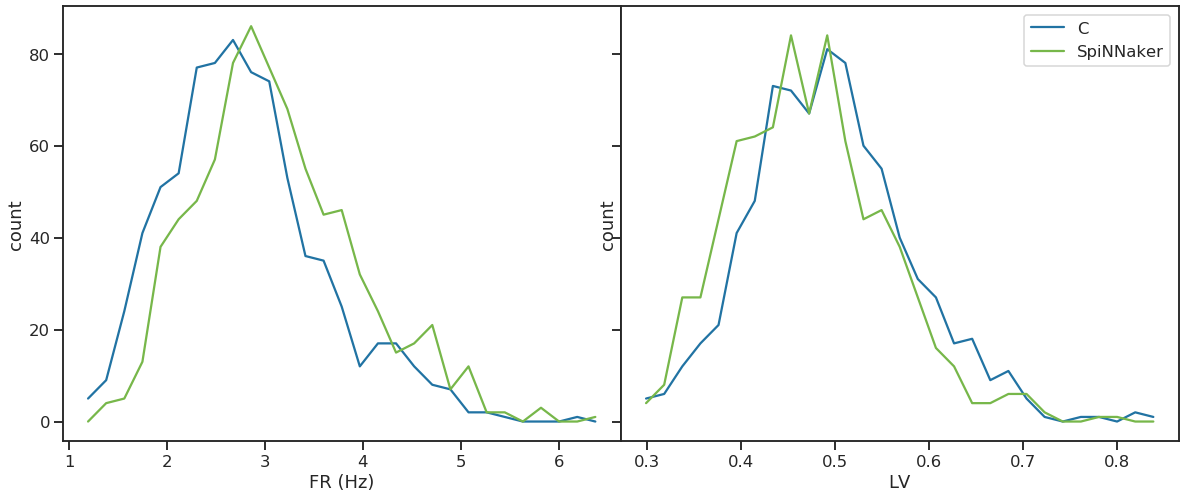
… the test classes are also able to visualize the the generated samples.
[9]:
fig, ax = plt.subplots(ncols=2, sharey=True, gridspec_kw={'wspace':0}, figsize=(20,8))

FR_test.visualize_samples(C, S, ax=ax[0], var_name='FR (Hz)', bins=30, density=False)
LV_test.visualize_samples(C, S, ax=ax[1], var_name='LV', bins=30, density=False);
No handles with labels found to put in legend.
What can tests do?
… to perform the actual validation and calculate a test score, you call the judge() function, which will 1. check if the model has all the required capabilities. 2. call generate_prediction() 3. call compute_score() 4. check that the score is of score_type 5. equip the score with metadata 6. returns the score.
[10]:
# For a model-to-model test the two models are passed as a list
print('FR test:\n', FR_test.judge([C, S]).score)
FR test:
                   C  SpiNNaker
C          0.000000   0.394106
SpiNNaker  0.394106   0.000000
[11]:
# to access an element of the score DataFrame use
print('FR-Test ', FR_test.judge([C, S]).iloc[1,0])
print('LV-Test ', LV_test.judge([C, S]).iloc[1,0])
# print of a score instance invokes the __str__ property of the test
FR-Test

Effect Size
        datasize: 800    800
        Effect Size = 0.394      CI = (0.295, 0.493)


LV-Test

Effect Size
        datasize: 800    800
        Effect Size = 0.271      CI = (0.172, 0.369)
Using a different statistical test as score type is as simple as
[12]:
class FR_ks_test_class(sciunit.TestM2M, tests.firing_rate_test):
    score_type = scores.ks_distance # students_t, kl_divergence, mwu_statistic, best_effect_size, LeveneScore

FR_ks_test = FR_ks_test_class()

print(FR_ks_test.judge([C, S]).iloc[1,0])
Kolmogorov-Smirnov-Distance
        datasize: 800    800
        D_KS = 0.185     p value = 2.23e-12
That’s all good and fine but what about experimental data !?!?!?
The experimental data for this example is taken from Brochier et al. (2018). The provided datasets were recorded in the motor cortex of two macaque monkeys using Utah multi-electrode arrays. The underlying task was an instructed delayed reach-to-grasp task, the details of which are described in Riehle et al. (2013) and Brochier et al. (2018).
load the data and utility functions (local)
[13]:
# Clone repository (this will not download large data files)
!git clone git@gin.g-node.org:/doi/multielectrode_grasp.git

# download large data files needed for this example
os.chdir('./multielectrode_grasp')
!git-annex get ./datasets/l101210-001.odml # metadata for monkey L
!git-annex get ./datasets/l101210-001.ns2 # analog signals for monkey L
!git-annex get ./datasets/l101210-001.ccf
!git-annex get ./datasets/l101210-001.nev # unsorted spike times for monkey L
!git-annex get ./datasets/l101210-001-02.nev # sorted spike times for monkey L
!git-annex get ./datasets/i140703-001.odml # metadata for monkey I
!git-annex get ./datasets/i140703-001.ns2 # analog signals monkey I
!git-annex get ./datasets/i140703-001.ccf
!git-annex get ./datasets/i140703-001.nev # unsorted spike times for monkey I
!git-annex get ./datasets/i140703-001-03.nev # sorted spike times for monkey I
os.chdir('..')

# set data path
download_path = "./multielectrode_grasp/"
data_path = './multielectrode_grasp/datasets/'
Cloning into 'multielectrode_grasp'...
remote: Enumerating objects: 4061, done.
remote: Counting objects: 100% (4061/4061), done.
remote: Compressing objects: 100% (2796/2796), done.
remote: Total 4061 (delta 1097), reused 1927 (delta 228)
Receiving objects: 100% (4061/4061), 3.86 MiB | 4.18 MiB/s, done.
Resolving deltas: 100% (1097/1097), done.
(merging origin/git-annex origin/synced/git-annex into git-annex...)
(recording state in git...)
get datasets/l101210-001.odml (from origin...)
MD5-s2782094--eac81b0562c9cfff8ddda263095990b1
      2,782,094 100%    3.87MB/s    0:00:00 (xfr#1, to-chk=0/1)
(checksum...) ok
(recording state in git...)
get datasets/l101210-001.ns2 (from origin...)
MD5-s8511032--66d7cca0ec1479056b561fa85c6d222b
      8,511,032 100%    4.74MB/s    0:00:01 (xfr#1, to-chk=0/1)
(checksum...) ok
(recording state in git...)
get datasets/l101210-001.ccf (from origin...)
MD5-s108204--dd2be8e8417f21a1e61da5e90e65f386
        108,204 100%    5.43MB/s    0:00:00 (xfr#1, to-chk=0/1)
(checksum...) ok
(recording state in git...)
get datasets/l101210-001.nev (from origin...)
MD5-s287712104--498b5d5cdd51b5b7a2ba05481c185c8f
    287,712,104 100%    9.77MB/s    0:00:28 (xfr#1, to-chk=0/1)
(checksum...) ok
(recording state in git...)
get datasets/l101210-001-02.nev (from origin...)
MD5-s287712104--50e8b4ddbd88d02145e8fd27edd2c89a
    287,712,104 100%    8.75MB/s    0:00:31 (xfr#1, to-chk=0/1)
(checksum...) ok
(recording state in git...)
get datasets/i140703-001.odml (from origin...)
MD5-s2433387--92bd01b6ed03062e6d8b6082ebd05b0c
      2,433,387 100%    7.41MB/s    0:00:00 (xfr#1, to-chk=0/1)
(checksum...) ok
(recording state in git...)
get datasets/i140703-001.ns2 (from origin...)
MD5-s204661895--b1a081853671a5c1e74c0d3ba9e62e84
    204,661,895 100%    9.35MB/s    0:00:20 (xfr#1, to-chk=0/1)
(checksum...) ok
(recording state in git...)
get datasets/i140703-001.ccf (from origin...)
MD5-s187076--10d198df25a921669f01b40c9eb3a8c8
        187,076 100%    6.61MB/s    0:00:00 (xfr#1, to-chk=0/1)
(checksum...) ok
(recording state in git...)
get datasets/i140703-001.nev (from origin...)
MD5-s168323228--a9f5d017dacfffe571070a3157de37d9
    168,323,228 100%    8.19MB/s    0:00:19 (xfr#1, to-chk=0/1)
(checksum...) ok
(recording state in git...)
get datasets/i140703-001-03.nev (from origin...)
MD5-s168323228--2c19fedac036b789e3a1192541a6f338
    168,323,228 100%    6.83MB/s    0:00:23 (xfr#1, to-chk=0/1)
(checksum...) ok
(recording state in git...)
load the data and utility functions (on server)
[14]:
!( echo "code/reachgraspio/reachgraspio.py" \
&& echo "code/neo_utils.py" \
&& echo "datasets/l101210-001.odml" \
&& echo "datasets/l101210-001.ns2" \
&& echo "datasets/l101210-001.nev" \
&& echo "datasets/l101210-001-02.nev" \
&& echo "datasets/i140703-001.odml" \
&& echo "datasets/i140703-001.ns2" \
&& echo "datasets/i140703-001.ccf" \
&& echo "datasets/i140703-001.nev" \
&& echo "datasets/i140703-001-03.nev") \
> download_files.txt
!wget -nH -nc -r -np -e robots=off -i download_files.txt -B https://web.gin.g-node.org/doi/multielectrode_grasp/raw/master/
download_path = "./doi/multielectrode_grasp/raw/master/"
data_path = download_path + 'datasets/'
--2019-07-24 14:43:56--  https://web.gin.g-node.org/doi/multielectrode_grasp/raw/master/code/reachgraspio/reachgraspio.py
Resolving web.gin.g-node.org (web.gin.g-node.org)... 141.84.41.219
Connecting to web.gin.g-node.org (web.gin.g-node.org)|141.84.41.219|:443... connected.
HTTP request sent, awaiting response... 301 Moved Permanently
Location: https://gin.g-node.org/doi/multielectrode_grasp/raw/master/code/reachgraspio/reachgraspio.py [following]
--2019-07-24 14:43:56--  https://gin.g-node.org/doi/multielectrode_grasp/raw/master/code/reachgraspio/reachgraspio.py
Resolving gin.g-node.org (gin.g-node.org)... 141.84.41.219
Connecting to gin.g-node.org (gin.g-node.org)|141.84.41.219|:443... connected.
HTTP request sent, awaiting response... 200 OK
Length: unspecified [text/plain]
Saving to: ‘doi/multielectrode_grasp/raw/master/code/reachgraspio/reachgraspio.py’

doi/multielectrode_     [ <=>                ]  73,83K   485KB/s    in 0,2s

2019-07-24 14:43:57 (485 KB/s) - ‘doi/multielectrode_grasp/raw/master/code/reachgraspio/reachgraspio.py’ saved [75597]

--2019-07-24 14:43:57--  https://web.gin.g-node.org/doi/multielectrode_grasp/raw/master/code/neo_utils.py
Connecting to web.gin.g-node.org (web.gin.g-node.org)|141.84.41.219|:443... connected.
HTTP request sent, awaiting response... 301 Moved Permanently
Location: https://gin.g-node.org/doi/multielectrode_grasp/raw/master/code/neo_utils.py [following]
--2019-07-24 14:43:57--  https://gin.g-node.org/doi/multielectrode_grasp/raw/master/code/neo_utils.py
Connecting to gin.g-node.org (gin.g-node.org)|141.84.41.219|:443... connected.
HTTP request sent, awaiting response... 200 OK
Length: unspecified [text/plain]
Saving to: ‘doi/multielectrode_grasp/raw/master/code/neo_utils.py’

doi/multielectrode_     [ <=>                ]  30,15K  --.-KB/s    in 0,1s

2019-07-24 14:43:57 (211 KB/s) - ‘doi/multielectrode_grasp/raw/master/code/neo_utils.py’ saved [30878]

--2019-07-24 14:43:57--  https://web.gin.g-node.org/doi/multielectrode_grasp/raw/master/datasets/l101210-001.odml
Connecting to web.gin.g-node.org (web.gin.g-node.org)|141.84.41.219|:443... connected.
HTTP request sent, awaiting response... 301 Moved Permanently
Location: https://gin.g-node.org/doi/multielectrode_grasp/raw/master/datasets/l101210-001.odml [following]
--2019-07-24 14:43:57--  https://gin.g-node.org/doi/multielectrode_grasp/raw/master/datasets/l101210-001.odml
Connecting to gin.g-node.org (gin.g-node.org)|141.84.41.219|:443... connected.
HTTP request sent, awaiting response... 200 OK
Length: unspecified [text/plain]
Saving to: ‘doi/multielectrode_grasp/raw/master/datasets/l101210-001.odml’

doi/multielectrode_     [   <=>              ]   2,65M  4,74MB/s    in 0,6s

2019-07-24 14:43:58 (4,74 MB/s) - ‘doi/multielectrode_grasp/raw/master/datasets/l101210-001.odml’ saved [2782094]

--2019-07-24 14:43:58--  https://web.gin.g-node.org/doi/multielectrode_grasp/raw/master/datasets/l101210-001.ns2
Connecting to web.gin.g-node.org (web.gin.g-node.org)|141.84.41.219|:443... connected.
HTTP request sent, awaiting response... 301 Moved Permanently
Location: https://gin.g-node.org/doi/multielectrode_grasp/raw/master/datasets/l101210-001.ns2 [following]
--2019-07-24 14:43:58--  https://gin.g-node.org/doi/multielectrode_grasp/raw/master/datasets/l101210-001.ns2
Connecting to gin.g-node.org (gin.g-node.org)|141.84.41.219|:443... connected.
HTTP request sent, awaiting response... 200 OK
Length: unspecified [application/octet-stream]
Saving to: ‘doi/multielectrode_grasp/raw/master/datasets/l101210-001.ns2’

doi/multielectrode_     [       <=>          ]   8,12M   535KB/s    in 10s

2019-07-24 14:44:09 (795 KB/s) - ‘doi/multielectrode_grasp/raw/master/datasets/l101210-001.ns2’ saved [8511032]

--2019-07-24 14:44:09--  https://web.gin.g-node.org/doi/multielectrode_grasp/raw/master/datasets/l101210-001.nev
Connecting to web.gin.g-node.org (web.gin.g-node.org)|141.84.41.219|:443... connected.
HTTP request sent, awaiting response... 301 Moved Permanently
Location: https://gin.g-node.org/doi/multielectrode_grasp/raw/master/datasets/l101210-001.nev [following]
--2019-07-24 14:44:09--  https://gin.g-node.org/doi/multielectrode_grasp/raw/master/datasets/l101210-001.nev
Connecting to gin.g-node.org (gin.g-node.org)|141.84.41.219|:443... connected.
HTTP request sent, awaiting response... 200 OK
Length: unspecified [application/octet-stream]
Saving to: ‘doi/multielectrode_grasp/raw/master/datasets/l101210-001.nev’

doi/multielectrode_     [             <=>    ] 274,38M  9,57MB/s    in 35s

2019-07-24 14:44:45 (7,78 MB/s) - ‘doi/multielectrode_grasp/raw/master/datasets/l101210-001.nev’ saved [287712104]

--2019-07-24 14:44:45--  https://web.gin.g-node.org/doi/multielectrode_grasp/raw/master/datasets/l101210-001-02.nev
Connecting to web.gin.g-node.org (web.gin.g-node.org)|141.84.41.219|:443... connected.
HTTP request sent, awaiting response... 301 Moved Permanently
Location: https://gin.g-node.org/doi/multielectrode_grasp/raw/master/datasets/l101210-001-02.nev [following]
--2019-07-24 14:44:45--  https://gin.g-node.org/doi/multielectrode_grasp/raw/master/datasets/l101210-001-02.nev
Connecting to gin.g-node.org (gin.g-node.org)|141.84.41.219|:443... connected.
HTTP request sent, awaiting response... 200 OK
Length: unspecified [application/octet-stream]
Saving to: ‘doi/multielectrode_grasp/raw/master/datasets/l101210-001-02.nev’

doi/multielectrode_     [         <=>        ] 274,38M  3,43MB/s    in 34s

2019-07-24 14:45:18 (8,19 MB/s) - ‘doi/multielectrode_grasp/raw/master/datasets/l101210-001-02.nev’ saved [287712104]

--2019-07-24 14:45:18--  https://web.gin.g-node.org/doi/multielectrode_grasp/raw/master/datasets/i140703-001.odml
Connecting to web.gin.g-node.org (web.gin.g-node.org)|141.84.41.219|:443... connected.
HTTP request sent, awaiting response... 301 Moved Permanently
Location: https://gin.g-node.org/doi/multielectrode_grasp/raw/master/datasets/i140703-001.odml [following]
--2019-07-24 14:45:19--  https://gin.g-node.org/doi/multielectrode_grasp/raw/master/datasets/i140703-001.odml
Connecting to gin.g-node.org (gin.g-node.org)|141.84.41.219|:443... connected.
HTTP request sent, awaiting response... 200 OK
Length: unspecified [text/plain]
Saving to: ‘doi/multielectrode_grasp/raw/master/datasets/i140703-001.odml’

doi/multielectrode_     [        <=>         ]   2,32M  1,49MB/s    in 1,6s

2019-07-24 14:45:21 (1,49 MB/s) - ‘doi/multielectrode_grasp/raw/master/datasets/i140703-001.odml’ saved [2433387]

--2019-07-24 14:45:21--  https://web.gin.g-node.org/doi/multielectrode_grasp/raw/master/datasets/i140703-001.ns2
Connecting to web.gin.g-node.org (web.gin.g-node.org)|141.84.41.219|:443... connected.
HTTP request sent, awaiting response... 301 Moved Permanently
Location: https://gin.g-node.org/doi/multielectrode_grasp/raw/master/datasets/i140703-001.ns2 [following]
--2019-07-24 14:45:21--  https://gin.g-node.org/doi/multielectrode_grasp/raw/master/datasets/i140703-001.ns2
Connecting to gin.g-node.org (gin.g-node.org)|141.84.41.219|:443... connected.
HTTP request sent, awaiting response... 200 OK
Length: unspecified [application/octet-stream]
Saving to: ‘doi/multielectrode_grasp/raw/master/datasets/i140703-001.ns2’

doi/multielectrode_     [       <=>          ] 195,18M  8,02MB/s    in 31s

2019-07-24 14:45:53 (6,21 MB/s) - ‘doi/multielectrode_grasp/raw/master/datasets/i140703-001.ns2’ saved [204661895]

--2019-07-24 14:45:53--  https://web.gin.g-node.org/doi/multielectrode_grasp/raw/master/datasets/i140703-001.ccf
Connecting to web.gin.g-node.org (web.gin.g-node.org)|141.84.41.219|:443... connected.
HTTP request sent, awaiting response... 301 Moved Permanently
Location: https://gin.g-node.org/doi/multielectrode_grasp/raw/master/datasets/i140703-001.ccf [following]
--2019-07-24 14:45:53--  https://gin.g-node.org/doi/multielectrode_grasp/raw/master/datasets/i140703-001.ccf
Connecting to gin.g-node.org (gin.g-node.org)|141.84.41.219|:443... connected.
HTTP request sent, awaiting response... 200 OK
Length: unspecified [application/octet-stream]
Saving to: ‘doi/multielectrode_grasp/raw/master/datasets/i140703-001.ccf’

doi/multielectrode_     [ <=>                ] 182,69K  --.-KB/s    in 0,08s

2019-07-24 14:45:54 (2,26 MB/s) - ‘doi/multielectrode_grasp/raw/master/datasets/i140703-001.ccf’ saved [187076]

--2019-07-24 14:45:54--  https://web.gin.g-node.org/doi/multielectrode_grasp/raw/master/datasets/i140703-001.nev
Connecting to web.gin.g-node.org (web.gin.g-node.org)|141.84.41.219|:443... connected.
HTTP request sent, awaiting response... 301 Moved Permanently
Location: https://gin.g-node.org/doi/multielectrode_grasp/raw/master/datasets/i140703-001.nev [following]
--2019-07-24 14:45:54--  https://gin.g-node.org/doi/multielectrode_grasp/raw/master/datasets/i140703-001.nev
Connecting to gin.g-node.org (gin.g-node.org)|141.84.41.219|:443... connected.
HTTP request sent, awaiting response... 200 OK
Length: unspecified [application/octet-stream]
Saving to: ‘doi/multielectrode_grasp/raw/master/datasets/i140703-001.nev’

doi/multielectrode_     [            <=>     ] 160,53M  7,92MB/s    in 25s

2019-07-24 14:46:19 (6,38 MB/s) - ‘doi/multielectrode_grasp/raw/master/datasets/i140703-001.nev’ saved [168323228]

--2019-07-24 14:46:19--  https://web.gin.g-node.org/doi/multielectrode_grasp/raw/master/datasets/i140703-001-03.nev
Connecting to web.gin.g-node.org (web.gin.g-node.org)|141.84.41.219|:443... connected.
HTTP request sent, awaiting response... 301 Moved Permanently
Location: https://gin.g-node.org/doi/multielectrode_grasp/raw/master/datasets/i140703-001-03.nev [following]
--2019-07-24 14:46:22--  https://gin.g-node.org/doi/multielectrode_grasp/raw/master/datasets/i140703-001-03.nev
Connecting to gin.g-node.org (gin.g-node.org)|141.84.41.219|:443... connected.
HTTP request sent, awaiting response... 200 OK
Length: unspecified [application/octet-stream]
Saving to: ‘doi/multielectrode_grasp/raw/master/datasets/i140703-001-03.nev’

doi/multielectrode_     [               <=>  ] 160,53M   545KB/s    in 11m 6s

2019-07-24 14:57:28 (247 KB/s) - ‘doi/multielectrode_grasp/raw/master/datasets/i140703-001-03.nev’ saved [168323228]

FINISHED --2019-07-24 14:57:28--
Total wall clock time: 13m 32s
Downloaded: 11 files, 1,1G in 13m 24s (1,34 MB/s)
Add utility code to the python path
[15]:
sys.path.insert(0, download_path + 'code')
sys.path.insert(0, download_path + 'code/reachgraspio')
from neo_utils import add_epoch, cut_segment_by_epoch, get_events
import reachgraspio as rgio
---------------------------------------------------------------
ModuleNotFoundError           Traceback (most recent call last)
<ipython-input-15-3e8741fa9b10> in <module>
      2 sys.path.insert(0, download_path + 'code/reachgraspio')
      3 from neo_utils import add_epoch, cut_segment_by_epoch, get_events
----> 4 import reachgraspio as rgio

~/Projects/NetworkUnit/examples/doi/multielectrode_grasp/raw/master/code/reachgraspio/reachgraspio.py in <module>
     48
     49 import numpy as np
---> 50 import odml.tools
     51 import quantities as pq
     52

ModuleNotFoundError: No module named 'odml'
Define model classes as wrappers for the experimental data
[ ]:
class exp_data(models.experimental_data, capabilities.ProducesSpikeTrains):
    """
    A model class to load data from reach2grasp experiment. Spike times from the
    complete recording sessions are loaded.
    """

    def load(self, datfile, **kwargs):
        """
        Loads data from datfile.
        """
        # set paths
        fpath = data_path + datfile
        print('loading data from ' + fpath +'.nev')
        print('this may take a minute..')
        # load session and get event times
        session = rgio.ReachGraspIO(fpath, odml_directory=data_path)
        block = session.read_block(nsx_to_load='all', units='all', load_events=True, scaling='voltage')
        data_segment = block.segments[0]
        start_event = get_events(data_segment, properties={
                'trial_event_labels': self.params['start_trigger'],
                'performance_in_trial': session.performance_codes['correct_trial']})[0]
        stop_event = get_events(data_segment, properties={
                'trial_event_labels': self.params['stop_trigger'],
                'performance_in_trial': session.performance_codes['correct_trial']})[0]
        # select segments and get spiketrains
        selected_trial_segments = self.select_trial_segments(data_segment, start_event, stop_event)
        spiketrains = self.get_spiketrains(selected_trial_segments)

        return spiketrains


    def select_trial_segments(self, data_segment, start_event, stop_event, **kwargs):
        '''
        Filters out trials from given data_segment
        '''
        epoch = add_epoch(data_segment, event1=start_event, event2=stop_event, attach_result=False)
        cut_trial_block = neo.Block(name="Cut_Trials")
        cut_trial_block.segments = cut_segment_by_epoch(data_segment, epoch, reset_time=True)
        selected_trial_segments = []
        for tr_typ in self.params['trial_types']:
            selected_trial_segments.extend(cut_trial_block.filter(targdict={'belongs_to_trialtype': tr_typ},
                                                                  objects=neo.Segment))
        self.n_trials = len(selected_trial_segments)
        self.n_units = len(selected_trial_segments[0].filter({'sua': True}))
        return selected_trial_segments


    def get_spiketrains(self, selected_trial_segments, **kwargs):
        '''
        Appends all spike trains in selected_trial_segments to a list
        of spike trains. Spike trains with SNR<2.5 are sorted out.
        '''
        spiketrains = []
        for seg_id, seg in enumerate(selected_trial_segments):
            # Discarding non-valid trials
            if seg.annotations['trial_id'] == -1:
                continue
            # Selecting only the SUAs
            for st in seg.filter({'sua': True}):
                # Check the SNR, only use units with SNR>2.5 (see Brochier et al, 2018)
                if st.annotations['SNR'] > 2.5:
                    st.annotations['trial_id'] = seg.annotations['trial_id']
                    st.annotations['trial_type'] = seg.annotations['belongs_to_trialtype']
                    st.annotate(trial_id_trialtype=seg_id)
                    spiketrains.append(st)
        return spiketrains
Define derived model classes for each monkey
TS_ON : trial start
CUE-ON : grip type signal (800ms after TS_ON)
PG / SG : precision grip / side grip
LF / HF : low force / high force
spike trains with SNR < 2.5 are discarded
A general experimental data class is defined, which is the basis to load the two data sets into the NetworkUnit framework. For the sake of simplicity, we load all the single unit activity data within a fixed time window of 800ms ranging from ‘TS_ON’ to ‘CUE_ON’. ‘TS_ON’ defines the start of the trial and 800ms later the grip type is signalled by ‘CUE_ON’. This means that there is no trial type information in the given time window. The data is handed over to NetworkUnit as a list of spiketrains with n_units * n_trial elements. Spike trains are discarded if their signal to noise ration is small (SNR<2.5).
[ ]:
# Monkey L
class exp_class_L(exp_data):
    datfile = 'l101210-001'
    params = {'start_trigger': 'TS-ON',
              'stop_trigger': 'CUE-ON',
              'trial_types': ['PGLF', 'PGHF', 'SGLF', 'SGHF'],
              'color': '#ff8000'
              }

# Monkey I
class exp_class_I(exp_data):
    datfile = 'i140703-001'
    params = {'start_trigger': 'TS-ON',
              'stop_trigger': 'CUE-ON',
              'trial_types': ['PGLF', 'PGHF', 'SGLF', 'SGHF'],
              'color': '#9b59b6'
              }
[ ]:
L = exp_class_L(name='Monkey L')
I = exp_class_I(name='Monkey I')
Show spiking activity data
[ ]:
fig, ax = plt.subplots(nrows=2, sharex=True,
                       gridspec_kw={'hspace':0},
                       figsize=(35,12))

for exp_count, exp in enumerate([L, I]):
    exp.produce_spiketrains()
    for st_count, st in enumerate(exp.spiketrains):
        ax[exp_count].plot(st, [st_count]*len(st),
                           color=exp.params['color'],
                           marker='.', markersize=1.,
                           linestyle="None")

    ax[exp_count].set_ylabel(exp.name)
ax[-1].set_xlabel('t [ms]');
We use the same tests as before to compare the data sets
[ ]:
fig, ax = plt.subplots(ncols=2, sharey=True, gridspec_kw={'wspace':0}, figsize=(20,8))

FR_test.visualize_samples(L, I, ax=ax[0], var_name='FR (Hz)', bins=30, density=False)
LV_test.visualize_samples(L, I, ax=ax[1], var_name='LV', bins=30, density=False);
[ ]:
print('FR-Test ', FR_test.judge([C, S]).iloc[1,0])
print('LV-Test ', LV_test.judge([C, S]).iloc[1,0])
Conclusion
Validation testing on the level of network activity is a useful apprach (complementary to single-cell validation) to evaluate network models
NetworkUnit can be used to quantify the statistical difference between models and experimental data sets
Validation testing is applicable for
comparing model predictions to experimental findings,
guiding the model development,
checking for consistency within or across models (or data sets).
“A model, like a novel, may resonate with nature, but it is not a ‘real’ thing. Like novel, a model may be convinving - it may ‘ring true’ if it is consistent with our experience of the natural world. But just as we may wonder how much the characters in a novel are drawn from real life and how much is artifice, we might ask the same of a model: How much is based on observation and measurement of accesssible phenomena, how much is based on informed judgment, and how much is convencience?”
Orsekes, 1994
References
Trensch et al. (2018) Rigorous neural network simulations: model cross-validation665for boosting the correctness of simulation results, Frontiers in Neuroinformatics 12:81, doi: 10.3389/fninf.2018.00081
Gutzen et al. (2018) Reproducible neural network simulations: model validation on the level of network activity data, Frontiers in Neuroinformatics 12:90, doi: 10.3389/fninf.2018.00090
Schlesinger, S. (1979). Terminology for model credibility, Simulation 32, 103-104. doi: 10.1177/003754977903200304
Izhikevich, E. M. (2006). Polychronization: Computation with spikes, Neural Computation 18, 245–282. doi: 10.1162/089976606775093882
Brochier et al. (2018) Massively parallel recordings in macaque motor cortex during an instructed delayed reach-to-grasp task, Scientific Data, 5, pp. 1–23. doi: 10.1038/sdata.2018.55.
Riehle et al. (2013) Mapping the spatio-temporal structure of motor cortical LFP and spiking activities during reach-to-grasp movements, Frontiers in Neural Circuits, 7(48). doi: 10.3389/fncir.2013.00048.